JOSIAH MCELHENY
CONVENES
RAVEN CHACON, JENNIE C. JONES, GEORGE LEWIS, AND FRED MOTEN
TO TALK AND LISTEN
CONVENES
RAVEN CHACON, JENNIE C. JONES, GEORGE LEWIS, AND FRED MOTEN
TO TALK AND LISTEN
Thursday,
October 1, 2026
6:30pm
Doors
7pm
Event begins
SOLD OUT
Live on Montez Press Radio
Standby tickets may become available at the door.
October 1, 2026
6:30pm
Doors
7pm
Event begins
SOLD OUT
Live on Montez Press Radio
Standby tickets may become available at the door.
[2026, summer, over a few meals]Jennie: I’ve always been sort of obsessed with my inability to understand limb independence.
George: What’s that?
Jennie: Limb independence and the ability to be—I don't know, I just think there's something about how you are a core, and then your singular body has four independent structures. As someone who’s a non-drummer, I always get onto the poetics of what that means. And then you have this larger metaphor of how the structure works when there’s a singular core and all these individual branches, but they are one body.
Josiah: Well, it’s a very Milford Graves kind of thing, he could play fifteen against sixteen.
Fred: I’m convinced that the trap set, and by extension at least that particular version of limb independence, is a function of this hyper-individuation that is produced through the forms of torture that formed the economic management of slavery. So I actually think that limb independence is derived from cotton picking and cutting cane. I mean, it's a hypothesis, you know.
Raven: And also walking forward: as you go two by two.
Fred: Exactly. Your feet have to be moving in a certain rhythm. It’s not the same rhythm as your hands. Your hands are moving at different rhythms because one is picking and one is putting the cotton in the sack. This is all a function of the fact that people had to pick at a certain rate in order to avoid torture.
Raven: Maybe this limb independence can also be a kind of prompt for thinking about community organizing, about other kinds of action today, other kinds of breakage that we can do.
Jennie: Or phantom limbs, that memory of a thing that doesn’t exist anymore. Or that idea of playing to spirits that are not present. But I feel like we’re at a big mission drift moment where I don't understand the terrain around me anymore.
Fred: I'm assuming, Jennie, that when you said mission drift, it’s not just with regards to this particular conversation, but more generally, as in “what are we doing”? Right now, you know, in the world, what are we doing? And it feels to me like that’s always the question.
George: I think there were always people who were thinking about the larger implications of what they were doing musically. The AACM came along, and it was clearly not just about getting a gig, you know? But about what music could do for you. How it could change your life, how it could change society, how it could influence the world, and really move the world toward something new, how it could, you know, create new forms of consciousness.
Fred: And then we can think about music’s relationship to subsistence. If we think about subsistence in a larger and more general way. What does it mean to be trying to deal with truth and beauty in an era that is defined by a war against subsistence? And what is limb independence in relation to that?
[to be continued]
The artist Josiah McElheny convenes the composer Raven Chacon, the artist Jennie C. Jones, the composer George Lewis, and the writer Fred Moten to think about music and limb independence. To do that, each person has prepared some tracks to play and listen to together, and discuss.
This event takes place in conjunction with Josiah’s exhibition Instrument Object at The Kitchen (September 10 – November 7).
This event takes place in conjunction with Josiah’s exhibition Instrument Object at The Kitchen (September 10 – November 7).
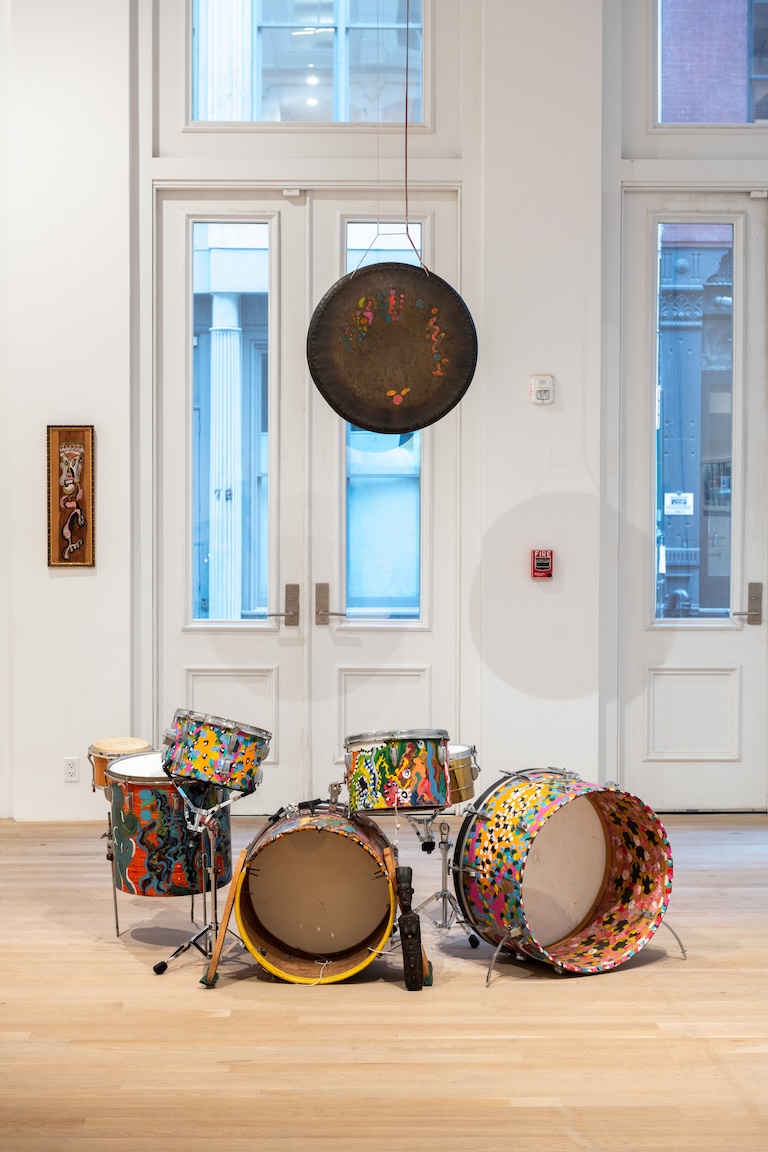
Milford Graves: Fundamental Frequency. Installation view (Hand-painted Drums, c.1970s; Earth Resonance, 2020; Untitled painting, c. 1980s), Artists Space, October 8, 2021 – January 15, 2022. Photo: Filip Wolak
This event is made possible with support from the John D. and Catherine T. MacArthur Foundation as part of Defying Boundaries: MacArthur Fellows at 45. Learn more at macfound.org/fellows-45.
Josiah McElheny (b. 1966, USA) is an artist. Recent solo exhibitions include The Kitchen in New York (2026); LACMA in Los Angeles (2024); Cantor Arts Center in Paolo Alto (2019); and Moody Center for the Arts in Houston (2018). He was awarded the MacArthur Fellowship in 2006. He lives in New York.
Raven Chacon (b. 1977, Navajo Nation) is a composer, performer, and installation artist. He has exhibited or performed at LACMA, the Whitney Museum, Borealis Festival, SITE Santa Fe, Swiss Institute Art, among many others. Chacon is the senior composer mentor for the Native American Composer Apprentice Project (NACAP). He was awarded the Pulitzer Prize in Music in 2022 and the MacArthur Fellowship in 2023. He lives in upstate New York.
Jennie C. Jones (b.1968, USA) is an artist. Recent solo exhibitions include the Pulitzer Arts Foundation in St. Louis (2025); the Roof Garden Commission at the Metropolitan Museum of Art in New York (2025); the Solomon R. Guggenheim Museum in New York, NY (2022); and the Arts Club of Chicago (2020). She lives in in Hudson, NY.
Raven Chacon (b. 1977, Navajo Nation) is a composer, performer, and installation artist. He has exhibited or performed at LACMA, the Whitney Museum, Borealis Festival, SITE Santa Fe, Swiss Institute Art, among many others. Chacon is the senior composer mentor for the Native American Composer Apprentice Project (NACAP). He was awarded the Pulitzer Prize in Music in 2022 and the MacArthur Fellowship in 2023. He lives in upstate New York.
Jennie C. Jones (b.1968, USA) is an artist. Recent solo exhibitions include the Pulitzer Arts Foundation in St. Louis (2025); the Roof Garden Commission at the Metropolitan Museum of Art in New York (2025); the Solomon R. Guggenheim Museum in New York, NY (2022); and the Arts Club of Chicago (2020). She lives in in Hudson, NY.
George Lewis (b. 1952, USA) is a composer, musicologist, and trombonist. He has been a member of the Association for the Advancement of Creative Musicians (AACM) since 1971 and is the author of A Power Stronger Than Itself: The AACM and American Experimental Music (2007), and the co-editor (with Harald Kisiedu) of Composing While Black: Afrodiasporic New Music Today (2023). Lewis is the Edwin H. Case Professor of American Music at Columbia University and Area Chair in Composition in the Department of Historical Musicology. He was awarded the MacArthur Fellowship in 2002. He lives in New York.
Fred Moten (b. 1962, USA) is a critic and poet. His books include In the Break: The Aesthetics of the Black Radical Tradition (2003), The Undercommons: Fugitive Planning & Black Study (with Stefano Harney, 2013), Black and Blur (2017), Stolen Life (2018), The Universal Machine (2018), All Incomplete (with Stefano Harney, 2021), and Perennial Fashion Presence Falling (2023), among others. He is Professor in the Departments of Performance Studies and Comparative Literature at NYU and was awarded the MacArthur Fellowship in 2020. He lives in upstate New York.
Fred Moten (b. 1962, USA) is a critic and poet. His books include In the Break: The Aesthetics of the Black Radical Tradition (2003), The Undercommons: Fugitive Planning & Black Study (with Stefano Harney, 2013), Black and Blur (2017), Stolen Life (2018), The Universal Machine (2018), All Incomplete (with Stefano Harney, 2021), and Perennial Fashion Presence Falling (2023), among others. He is Professor in the Departments of Performance Studies and Comparative Literature at NYU and was awarded the MacArthur Fellowship in 2020. He lives in upstate New York.
Due to the age and character of the building, the space is not optimized for ADA accessibility and is located up a single flight of 20 stairs with handrails. If you have questions about access, please contact us in advance of the event, and we will make every effort to accommodate you.
