PAUL CHAN
TALKS ABOUT
NAGARJUNA
Free, RSVP required
TALKS ABOUT
NAGARJUNA
Free, RSVP required
Monday,
December 14, 2026
6:30pm
Doors
7pm
Event begins
Limited capacity
December 14, 2026
6:30pm
Doors
7pm
Event begins
Limited capacity
On the occasion of a recent exhibition in Bangkok, the artist Paul Chan wrote a lecture about the great 2nd century Buddhist philosopher Nagarjuna.
“Nāgārjuna never explicitly wrote about art,” he says. “Still,” he continues, “I believe his views on form, motion, and the uses of contradiction can play a role in understanding how art matters, and why.”
“Nāgārjuna never explicitly wrote about art,” he says. “Still,” he continues, “I believe his views on form, motion, and the uses of contradiction can play a role in understanding how art matters, and why.”
He gives a new version of the lecture titled Nāgārjuna, or East of the Life, Death, and Afterlife of Art.
He explores the core Buddhist concepts in Nāgārjuna’s philosophy, how they resonate with ancient and modern thinkers from the West (like Sextus Empiricus and Hegel, among others), and offers an idiosyncratic account of art as a way of living and thinking in light of Nāgārjuna’s thought.
He explores the core Buddhist concepts in Nāgārjuna’s philosophy, how they resonate with ancient and modern thinkers from the West (like Sextus Empiricus and Hegel, among others), and offers an idiosyncratic account of art as a way of living and thinking in light of Nāgārjuna’s thought.
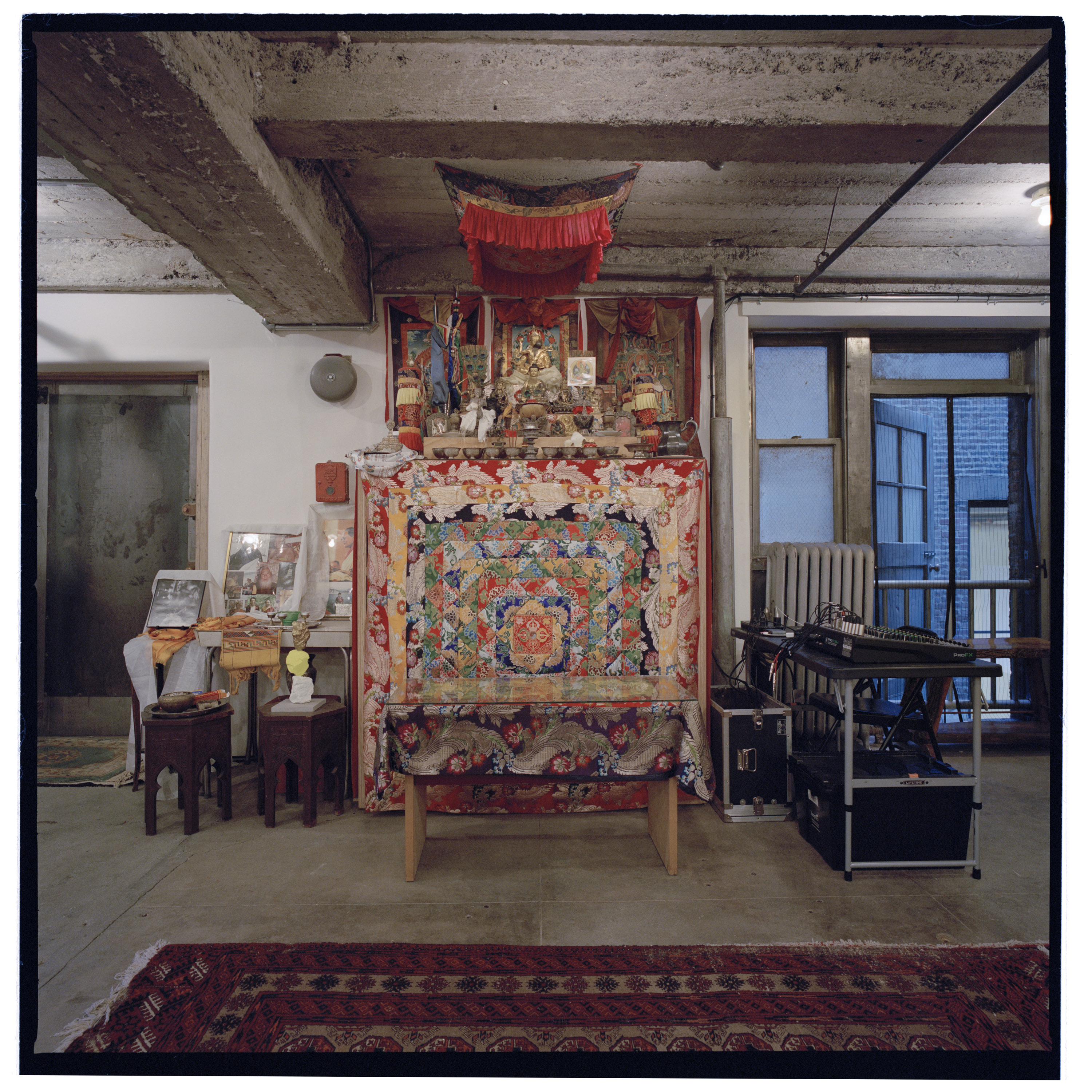
Buddhist shrine at 222 Bowery. Photo by Jason Fulford.
Paul Chan (b. 1973, Hong Kong) is an artist. Major solo exhibitions include Contemporary Art Museum, St Louis (2024), M+, Hong Kong (2023); Walker Art Center, Minneapolis (2022); Solomon R. Guggenheim Museum, New York (2015); Schaulager, Basel (2014); New Museum, New York (2008); and Serpentine Gallery, London (2007). He founded Badlands Unlimited (2010-2018), a press devoted to publishing artist writings and writings about art in paper and digital forms. He was named a MacArthur Foundation Fellow in 2022. He lives in New York.
Nāgārjuna (ca 150–250 CE) is the most important Buddhist philosopher after the historical Buddha himself and one of the most original and influential thinkers in the history of Indian philosophy. His philosophy of the “middle way” (madhyamaka) based around the central notion of “emptiness” (śūnyatā) influenced the Indian philosophical debate for a thousand years after his death. A specific reading of Nāgārjuna’s thought, called Prāsaṅgika-Madhyamaka, became the official philosophical position of Tibetan Buddhism, which regards it as the pinnacle of philosophical sophistication up to the present day.
Due to the age and character of the building, the space is not optimized for ADA accessibility and is located up a single flight of 20 stairs with handrails. If you have questions about access, please contact us in advance of the event, and we will make every effort to accommodate you.
